They walked in the way a lot of couples do: a little tired, a little skeptical, and holding hands anyway.
He was tall and broad through the shoulders. She was small, with a curve at the hip and waist that a flat surface would never quite reach. Before either of them said a word, I could see the shape of the problem, and I could see that we were going to solve it.
They’d been sleeping badly for years. Their last bed had been a compromise, chosen in a hurry with each of them giving a little so the other would be happy. Then the aches started, slowly, the way they do. A stiff lower back for her. A numb arm and a sore shoulder for him. They’d thrown out one bed, then another. They were tired of mattress shopping, and honestly, they were tired of being tired. They just wanted to get it right this time.
So before we touched a single bed, we talked. What are you hoping to fix? How are you actually sleeping? Where do you hurt, and when? What is this doing to your days?
And then, almost on cue, the line I hear from nearly every couple:
“I like it firm,” he said.
“I like a soft bed,” she said.
I smiled, because what I actually hear in that is two people who know they want something that helps them, and they’re in the right spot.
“The ground is firm,” I told him. “Firm doesn’t mean support.”
“Feathers are soft,” I told her. “Soft doesn’t mean they can lift you into alignment.”
They looked at each other. Neither of them had ever heard it put that way.
Support is something else entirely. It’s the bed’s ability to let the deeper parts of your body, his shoulders and her hips, conform in far enough that the hand-nested pocket springs make full contact along the whole length of you, and then push back with exactly the force needed to hold your spine straight. Too firm, and the shoulders and hips are propped up while the waist and lower back hang unsupported. Too soft, and the whole body sinks into a hammock. Neither one is support. Support is a bed that meets each of you where your body actually is.
And here’s the part that changes the conversation for couples: the right feel for him and the right feel for her may not be the same, because their bodies aren’t the same. That isn’t a problem to compromise around. It’s the whole point.
I had him lie down first, on a medium tension bed I’d chosen for his build. He settled in, and I asked him to notice his shoulder. It wasn’t hovering. It had gone into the bed, and the springs beneath it had come up to meet him. His arm lay easy at his side. “Oh,” he said. That’s usually the word.
Then her, on the same medium tension, but in a model chosen for its ability to conform more deeply, so her hip could go where it needed to go and the bed could rise to fill the space at her waist. I asked her to put her hand under the small of her back. Nothing. No gap. She laughed out loud.
Then we brought the two together, side by side, each on their own model in medium tension. They lay down at the same time. And then they went quiet.
That quiet is my favorite moment in this job. It’s two people realizing, at the exact same second, that they don’t have to give anything up. He isn’t sleeping on her bed. She isn’t sleeping on his. They’re sleeping on their own, together.
She reached over and found his hand without looking. “This one,” she said.
“This one,” he said.
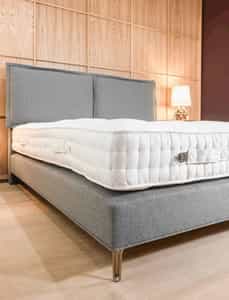
They left with two Twin XL beds in two different Vispring models, both in medium tension, joined side by side on a zip and link base, with a single topper to bring them together as one. His bed. Her bed. Their bed.
People come in thinking they’re shopping for a mattress. What they’re really shopping for is who they get to be when they’re rested.
A good night’s sleep changes your relationship with yourself first. You wake up without bracing for the ache. You have patience you didn’t have yesterday. You’re more even, more generous, quicker to laugh and slower to snap. The small irritations that felt enormous at 6 a.m. on four broken hours of sleep turn out to have been about the sleep all along.
And then it changes your relationship with each other. Couples who sleep well fight less about nothing. They have more warmth left over at the end of the day, because they didn’t spend it all getting through the day. They stop keeping score of who got the better side of the bed, because there is no better side anymore.
That couple didn’t just buy a bed. They stopped compromising on the one third of their lives they spend lying next to each other. They finally got to be comfortable in the same place, at the same time, each in the way their own body needed.
He likes it firm. She likes it soft. They were both right. They just needed a bed that could say yes to both of them.
 (212) 792-7911459 Broome St, New York, NY1500 Lafayette Road, Portsmouth, NH