Today, most people think of a mattress as a one-sided object: sleep on the top, rotate it occasionally, and replace it when the surface begins to sag.
It was not always that way.
For decades, a good mattress was made to be turned. Not rotated occasionally. Turned over completely.
Season after season, year after year, both sides of the mattress were used, rested, compressed, recovered, and used again. Turning was not an inconvenience added after purchase. It was part of the design logic of the bed itself.
Over time, that expectation faded so much that many people no longer realize it was once the standard.
When the Flip Disappeared
Then, almost quietly, that expectation disappeared.
For much of modern mattress history, turning a mattress was part of ownership. A mattress was not treated as a disposable object. It was something to be maintained, aired, rotated, turned, and used over many years.
This made sense because the mattress itself was built symmetrically. Both sides contained upholstery. Both sides were designed to receive pressure. Both sides were part of the sleep surface.
By the turn of the millennium, the mattress industry was changing. In 2000, Simmons Company introduced its “no-flip” mattress on a national basis, promoting a simple new advantage: consumers would no longer need to turn their mattresses. The concept helped mark a broader shift toward one-sided construction.
The appeal was obvious. A heavy mattress no longer had to be lifted and turned as part of routine ownership. But eliminating the flip did not simply remove a maintenance step. It changed the architecture of the mattress itself.
The difference is structural.
In a traditional turnable mattress, the spring system sits between two upholstered sleeping surfaces. Comfort materials are layered above and below the springs, allowing either side of the mattress to receive the body.
In a typical one-sided design, the architecture is different. The primary comfort layers are concentrated above the support system, while the underside is constructed as a base rather than a second sleeping surface. The mattress may still be rotated from head to foot, but it is not designed to be flipped and slept on from either side.
What disappeared, then, was not simply the ritual of turning a mattress. The mattress itself had been redesigned so that turning was no longer intended.
To the consumer, the change may have seemed minor. The mattress still looked like a mattress. It still had height, quilting, and a finished appearance. But structurally, something important had changed.
The mattress was no longer designed to age in the same way.
What Changed Inside the Mattress
| Feature | Traditional Turnable Mattress | Typical One-Sided Mattress |
|---|---|---|
| Construction | Upholstery on both sides of the support system | Primary comfort system concentrated on one side |
| Sleeping surfaces | Two usable sleeping surfaces | One primary sleeping surface |
| Care | Rotate and turn | Typically rotate only |
| Wear | Distributed across two sleeping surfaces | Concentrated on one sleeping surface |
Why One-Sided Mattresses Became the Standard
A double-sided mattress is more demanding to make.
From a manufacturing perspective, the economics are straightforward. A two-sided mattress requires upholstery and finishing on both sleeping surfaces. A one-sided design concentrates the comfort system on a single surface, reducing the need to duplicate the same construction beneath the spring unit.
Simplicity for the consumer and efficiency for the manufacturer were now pointing in the same direction. The mattress became simpler to maintain, and less complex to produce.
What disappeared in the process was something less immediately visible: a second side with a real role in the mattress’s working life.
The one-sided format would also prove well suited to another major change in the mattress business: the rise of direct-to-consumer beds sold online. Many foam-based mattresses could be compressed, rolled, boxed, and shipped through conventional delivery networks, helping make the mattress an increasingly accessible product to buy without ever entering a showroom.
The industry was becoming simpler to manufacture, simpler to ship, and simpler to buy. But those efficiencies reflected a very different philosophy from a mattress designed to be turned, maintained, and lived with over the long term.
That does not mean every one-sided mattress is poorly made, but it does mean the object has been designed with a different assumption about use.
A mattress built on one side asks the same surface to carry the full burden of sleep every night: the same shoulder zone, the same hip zone, the same pressure points, the same compression pattern, year after year.
There is no second side to share the load.
And over time, that matters.
What Turning Actually Does
Turning a mattress is not simply a habit from another era. It serves a structural purpose.
Each night, a mattress absorbs pressure from the body. The heaviest points, usually the shoulders, hips, and torso, compress the layers beneath them. Over time, those areas naturally experience more wear than others.
When a mattress is built to be turned, that wear can be distributed more evenly.
All cushioning materials change with repeated use. Areas that receive the greatest pressure night after night can soften and settle differently from the surrounding surface, contributing over time to body impressions. In a turnable mattress, nightly use can be shared across two sleeping surfaces rather than concentrated continuously on one.
Turning does not prevent materials from aging. It changes how that aging is distributed.
While one side is in use, the other is relieved from the same nightly pressure pattern, giving the fillings time to rest and recover. Turning gives the mattress a rhythm of use and recovery.
This is especially important in a mattress made with natural materials. Wool, horsetail, cashmere, silk, cotton, and other natural fillings are chosen for qualities such as breathability, resilience, moisture management, and comfort. But like all materials, they respond to repeated pressure. When they are allowed to rest, breathe, and recover, they can perform more beautifully over time.
A turnable mattress is not simply more traditional. It is more balanced by design.
The Vispring Approach
Turnable mattresses have not disappeared completely. But in a market increasingly built around one-sided construction, they have become far less commonplace.
Vispring never abandoned the two-sided mattress.
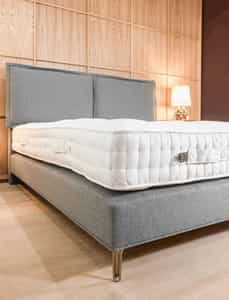
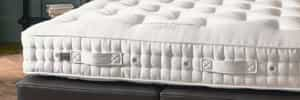
Vispring mattresses are traditionally constructed with natural fillings on both sides, rather than concentrating the upholstery on one face alone.
This is not nostalgia. It is a structural decision about how a mattress should age, recover, and perform over time.
Each side is designed to be slept on, carefully layered with natural fillings, and made part of the mattress’s working life.
Turning is part of Vispring’s recommended care because it helps distribute use and allows the natural fillings to settle more evenly over time.
This matters because a mattress should not be judged only by how it feels on the first night.
It should be judged by how it supports the body after years of use.
A one-sided mattress concentrates nightly use on a single sleeping surface. A Vispring is built to distribute that use across two upholstered surfaces, helping support an even wear over time.
The Long View of Value
The double-sided construction allows both sleeping surfaces to share the work over time. The natural fillings are given periods of rest and recovery.
There is also a consequence beyond the bedroom. A mattress is a substantial object to manufacture, transport, and eventually dispose of. Extending the useful life of a bed means delaying that replacement cycle and reducing how frequently another mattress must take its place.
Longevity, in that sense, is not only a question of value. It is also a question of consumption.
That is why longevity matters.
When a mattress is designed to be turned, cared for, and built for long-term use, its value is better understood across years of sleep rather than simply by its price on the day of purchase. The investment becomes less about buying a mattress and more about choosing a sleep system built to endure.
For clients who value quality, this is the real difference. A Vispring is designed around a long-term relationship between the sleeper and the bed.
Built for the Years After the First Night
Modern mattress marketing often focuses on the first impression: the initial softness, and the immediate comfort.
But sleep is not a first impression.
It is repetition.
Night after night, year after year, the mattress receives the body, supports its weight, manages pressure, responds to movement, and creates the conditions for recovery. A bed that performs beautifully at the beginning but loses its structure too quickly has not delivered lasting comfort. It has delivered only an opening moment.
What endures is what matters.
The quiet consistency.
The preserved support.
The comfort that does not collapse into compromise.
The confidence that the bed was built not only to impress, but to last.
That is why the turnable mattress still matters.
It reflects a different philosophy of making: one that respects materials, maintenance, and the years of sleep that follow the day of purchase.
Vispring has never abandoned that philosophy.
Because a mattress should not be built only for the night it arrives.
It should be built for the life that happens on it.
Visit the Vispring New York Showroom
Vispring New York welcomes private consultations at 459 Broome Street in SoHo, where clients can experience handcrafted British beds made with natural materials, pocket springs, and double-sided construction designed for long-term comfort and support.
To book a private appointment, visit vispringnyc.com/request-an-appointment or call 212-792-7911.
 (212) 792-7911459 Broome St, New York, NY1500 Lafayette Road, Portsmouth, NH