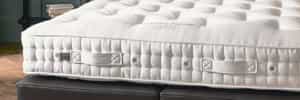
Most couples do not realize how often they are adjusting to each other’s movement at night.
A shared bed is where the physical realities of two different bodies meet. Two different body weights, two different sleep rhythms, and two different patterns of movement throughout the night. When one person turns, shifts posture, or gets out of bed at dawn, that movement transfers kinetic energy, and that energy has to travel somewhere. How the mattress manages that energy determines how much of it reaches the other sleeper.
In many mattresses, some of that movement travels across the sleep surface. A shift on the left side can register as a dip, a shudder, or a subtle pull on the right. You may not wake completely, but even small disturbances can interrupt otherwise continuous sleep, causing your body to adjust to movement that did not originate with you.
We often assume that waking up slightly tired next to someone is an inevitable compromise of sharing a bed. However, some of that disturbance comes down to something much more fundamental: how the mattress is engineered.
Sleep is not just the hours spent in bed. It shapes the quality of the hours that follow.
For couples, this becomes especially important because two people rarely move through the night in exactly the same way. One may fall asleep earlier. One may wake before dawn. One may turn frequently, sleep lightly, run warm, or shift position without realizing it. Over time, those differences can quietly affect both people.
When sleep is interrupted night after night, even in small ways, the cost is not limited to feeling tired in the morning. Rest influences energy, focus, mood, patience, recovery, and the ability to move through the day well. When sleep becomes fragmented, the effects can show up everywhere: in productivity, in emotional balance, in physical comfort, and even in the way couples feel around each other.
That is why the engineering of a shared mattress matters. A bed should not ask one person’s rest to depend on the other person staying perfectly still. It should support the reality of two different bodies, two different schedules, and two different sleep patterns, while allowing both people to wake restored.
Traditional innerspring systems take several forms. Bonnell and offset springs use individual coils mechanically connected to one another, while continuous-coil systems are formed from lengths of interconnected wire. In each case, movement in one part of the spring unit can influence the surrounding structure.
When one area is compressed by a shoulder or hip, the interconnected structure allows some of that movement to influence neighboring springs. From a mechanical perspective, the springs do not respond entirely in isolation. Rather than keeping the response concentrated at the point of pressure, movement can spread through the spring system and become noticeable to the person sleeping beside you.
Foam mattresses approach motion differently, absorbing movement within the material itself. This can be effective at reducing motion transfer, but it achieves that isolation through damping rather than independent mechanical response. The result is a fundamentally different feel from the responsive, buoyant support of an individually sprung mattress.
The true engineering challenge is not simply to deaden motion, but to isolate it while maintaining dynamic, buoyant physical support.
To reduce motion transfer without making the mattress feel flat or overly dampened, the mattress needs a support system that can respond locally. In other words, the movement created by one part of the body should stay as close as possible to where it begins, while the rest of the mattress continues supporting the sleeper independently.
The answer arrived more than a century ago. In 1899, James Marshall created the first pocket-spring mattress, with each spring sewn into its own fabric pocket so it could respond more independently. In 1901, John Nolon and Frederick James introduced Marshall’s innovation to the UK, founding the Marshall Sanitary Mattress Company in London.
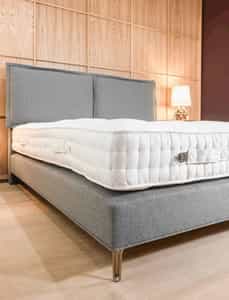
Today, every Vispring spring is made in-house at the workshop in Plymouth, England. Each spring is custom-made from high-grade vanadium steel for strength, flexibility, and long-term responsiveness. Vispring uses nine different wire gauges and 74 distinct spring types, allowing the spring system to be tailored more precisely to different body weights, comfort preferences, and support requirements.
Each spring is then enclosed in its own individual pocket of natural, unbleached calico cotton. Pocket springs change the mechanics of the mattress by allowing each coil to respond independently to the pressure applied to it. Instead of asking an interconnected spring unit to respond as a system, the response becomes far more localized:
Independence does not depend only on the spring itself. It also depends on how those springs are arranged.
Many pocket spring systems use synthetic fabric pockets joined together in straight rows with adhesive. While the springs remain individually pocketed, joining the pockets in this way creates connections between them that can influence how independently the spring unit responds.
Inside a Vispring, the spring rows are not glued together. Instead, artisans hand-nest the calico-covered springs in a dense honeycomb formation, preserving the independent responsiveness of the spring unit.
The honeycomb formation allows the springs to be nested closely together, creating a high density of individually responsive coils while preserving their ability to move independently. As pressure shifts across the mattress, the springs respond locally to subtle changes in weight and position rather than requiring the spring unit to move as one interconnected structure.
The consequence of motion transfer is not always full wakefulness. In fact, you may not remember being disturbed at all.
What happens instead is a series of small sleep disruptions, sometimes referred to as sleep fragmentation. Each time your partner turns, changes position, or gets out of bed, subtle movement can travel through the mattress, prompting your body to adjust to a disturbance that did not originate with you, even if you never fully wake.
Over the course of a night, those small disruptions accumulate. Sleep feels less continuous, less settled, and less restorative than it should. You wake without remembering a single disturbance, only knowing that the night felt less restorative than it should have.
Reducing those unnecessary disturbances helps create a more stable environment for continuous, restorative sleep.
When motion is absorbed locally at the spring level, the dynamic of sharing a bed changes fundamentally.
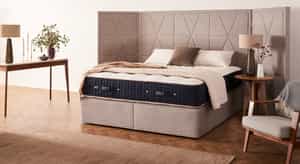
Your partner can turn, adjust, or leave the bed early while minimizing the movement that reaches your side of the mattress. With Vispring’s split-tension options, each side of the same mattress can also be tailored to the needs of a different sleeper, allowing two people with different body weights and comfort requirements to share one seamless bed.
A well-engineered bed should allow companionship and recovery to exist in the same space. It quietly manages the kinetic reality of two people sharing one bed, creating the stability and stillness that allow each person to rest more independently.
It is this kind of quiet consistency that defines a Vispring.
The difference is difficult to understand from a specification sheet alone. It is felt in the stillness of the mattress, in the way support remains personal to each sleeper, and in the quiet confidence of a bed engineered for two different bodies sharing one space.
Most couples do not realize how much they adjust to each other through the night until the bed stops asking them to.
That is the quiet architecture of shared sleep: not separating two sleepers, but supporting each one independently enough that both can rest together.
Vispring New York welcomes private consultations at 459 Broome Street in SoHo, where nine models are available to experience in a quiet setting, at your own pace.
To request a personal or private appointment, visit vispringnyc.com/request-an-appointment or call 212-792-7911.
 (212) 792-7911459 Broome St, New York, NY1500 Lafayette Road, Portsmouth, NH