The leadership literature has caught up to this framing. Sleep-deprived leaders score lower across problem-solving, results orientation, and interpersonal effectiveness. These are the exact competencies that justify an executive’s seat at the table.
The penalty is not abstract. It shows up in the second meeting of the afternoon, in the email that arrives a beat too late, in the conversation with a key client that goes slightly sideways. Chronic under-rest compounds, and in that context the compound is the point. Small degradations in cognitive function, accumulated over months, become the difference between a leader who sees clearly and one who does not.
Frequent travel and high cognitive load make the problem worse. Crossing time zones disrupts the circadian clock, and full adaptation takes roughly one day per zone crossed. Even without travel, the executive schedule fragments sleep architecture through late nights, early mornings, and the background stress of constant decision-making. The bedroom cannot reverse these forces, but it can absorb them, provided the room itself is engineered for recovery rather than treated as an afterthought.
What follows is a working blueprint. It opens with a specific case study of mattress engineering, moves through a decision framework that distinguishes firmness from support, weighs natural against synthetic materials, examines the bedroom as a controlled environment, lays out travel tactics, and closes with selection criteria and care practices. The thesis is straightforward: treat the master suite like any other performance asset, with the same attention to specification, maintenance, and measurement.
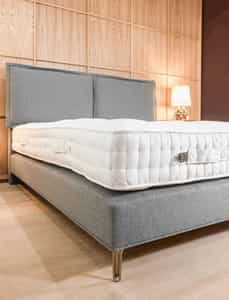
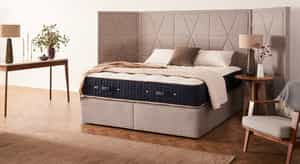
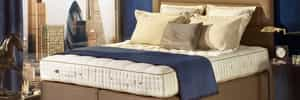
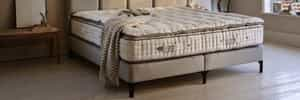
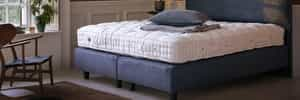
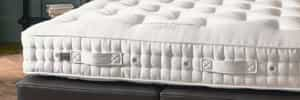
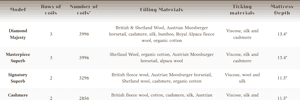
Vispring, a British manufacturer established in 1901, offers a useful reference point because its construction principles translate across the category. Each mattress is built around individually pocketed springs arranged in zoned configurations that respond to the body differently across its length. A queen or king model easily surpasses a thousand working components. The springs are hand-layered with natural fibers, including wool, horsehair, cashmere, and silk, chosen for breathability, moisture management, and pressure relief.
The engineering logic matters more than the heritage. Pocketed springs isolate motion. When a partner turns, the springs under the turning partner compress, and the kinetic energy of that movement does not transfer across the bed in the way it does with a continuous coil or a foam slab. Targeted zoning means firmer support under the lumbar region and gentler give under the shoulders, matching the body’s geometry rather than treating it as a uniform load. The result is a surface that holds the spine neutral through the night, which is the mechanical purpose of a mattress regardless of brand.
Vispring also makes a distinction the category often blurs. Their lineups offer surface feels from Plush Soft through Firm, and underneath those comfort layers lie multiple spring tensions that govern support. Firmness is the surface feel you notice when you lie down. Support is the mechanical function that keeps your spine aligned and redistributes pressure across the night. A mattress can feel soft and still be supportive, or feel firm and still fail to hold neutral posture. Heritage construction also adds a durability claim worth noting. Pocketed coils experience localized fatigue under the heaviest body zones rather than uniform collapse, which means a quality build can hold its mechanical properties for a decade or longer.
The distinction between firmness and support is the single most useful concept in mattress evaluation. Firmness describes the surface feel, how the top of the mattress responds when you first lie down. Support describes the underlying mechanical function: keeping the spine neutral, redistributing pressure across the body’s load points, and isolating motion from a partner. A mattress can rate high on one and low on the other, which is why showroom feel is an unreliable guide.
The outcomes tied to proper support are measurable. Spinal alignment achieved through appropriate firmness and zoned support has been associated with up to a 35% reduction in back-pain complaints, along with better sleep continuity. The mechanism is intuitive. When the spine rests in neutral, the muscles along its length do not have to fire through the night to hold posture. When a mattress fails to support, those muscles stay engaged, micro-arousals accumulate, and sleep architecture fragments even when total hours look adequate.
Selection should match spring tension and comfort level to body type, dominant sleep position, and partner dynamics. Side sleepers generally need more give at the shoulder and hip. Stomach and back sleepers need firmer lumbar support. Heavier bodies compress springs more, which means they often require higher spring tensions to keep the surface from bottoming out. Partner sleep introduces motion transfer as a real variable. Mismatched firmness creates pressure points, disrupts sleep architecture, and produces the next-day fatigue that no amount of caffeine resolves.
The natural-versus-synthetic conversation is often framed as a values question. It is more usefully framed as a performance question. Natural fibers, including wool, horsehair, cashmere, silk, natural latex, and cotton, breathe. They manage moisture and regulate temperature through the night in ways that synthetic foams generally do not. The thermal difference is not subtle. Closed-cell foam structures trap body heat, while natural fibers wick and release it.
Durability follows construction quality more than material category. Foam cellular collapse accelerates in lower-density foams; a 2.0 pound-per-cubic-foot foam can lose support in three to five years, while a 4.0 pound foam may sustain support for a decade or longer. Pocketed coils experience localized fatigue under the heaviest body zones rather than uniform collapse. A premium synthetic build can outlast a poorly constructed natural one, and vice versa. The label matters less than the density, gauge, and construction method behind it.
Allergen and antimicrobial performance offers a real, if narrow, advantage to certain natural materials. Natural latex, wool, and tightly woven cotton covers reduce dust mite and mold exposure, which thrive in the warm, moisture-trapping environment of a typical bed. GOTS-certified natural latex is highlighted as a long-term hypoallergenic option, though the term natural on a label does not by itself guarantee performance.
The cost calculus runs in a surprising direction. A premium mattress amortized over a ten-year lifespan lands somewhere between a dollar and a few dollars per night, depending on the build, which competes favorably with other performance investments once sleep-quality gains are priced in. The luxury objection doesn’t hold up once you look at the numbers.
A mattress alone does not determine sleep quality. The room around it does. Sleepers release moisture overnight, and modern airtight homes trap that moisture, degrading both mattress integrity and the thermal conditions required for deep sleep. The bedroom functions as a recovery environment, and the conditions in it matter.
Target ranges are well established. Ambient temperature between roughly 16 and 19°C supports the natural drop in core body temperature that initiates and sustains deep sleep. Humidity between 40 and 60% discourages both microbial growth and the dry-air irritation that fragments sleep. Active airflow around the mattress base, achieved through periodic linen pulling, breathable bedding, and avoiding fully sealed mattress foundations, prevents moisture from accumulating where the body rests for a third of every day.
Light is the other primary input. Morning bright light accelerates circadian re-entrainment after travel or a disruptive schedule; evening dimming signals the melatonin response that initiates sleep architecture. The thermal and light environments work as a single system, so adjusting one without the other gives incomplete results. Position the bedroom as you would position a training environment for an athlete, with inputs specified for outputs. Sleep is the output. The room is the input set.
Travel disrupts the system, and the disruption has a measurable cost. Full circadian adaptation takes roughly one day per time zone crossed, and for short trips, generally under three days, the math often favors holding the home time zone rather than chasing local time. The latter strategy trades one set of misalignments for another.
Light timing is the primary lever. Timed exposure to bright light, paired with pre-trip sleep shifting, blunts the disruption curve more reliably than any supplement stack. Melatonin cues and controlled evening dimming reinforce the signal. For trips short enough that adaptation is impractical, the goal is to keep the home rhythm intact, eat and sleep on home time, and accept the partial misalignment as the cost of doing business.
Hotel and cabin environments require their own stabilization. Eye masks, white noise, temperature overrides, and travel toppers reconstruct the recovery surface when the mattress is unknown. The more consistent the home baseline, the faster the executive can return to it, which makes the master suite a recovery anchor rather than just a sleeping space. For frequent cross-time-zone travelers, prioritizing motion isolation and rapid thermal recovery in the home mattress complements the travel protocol and shortens the return to baseline.
A buyer’s checklist, converted into prose, runs as follows. Specify zoned support appropriate to body type and sleep position, with attention to spring tension rather than surface feel alone. Confirm motion isolation adequate to your sleep partnership. Choose natural or certified hypoallergenic comfort layers if allergen exposure is a concern. Verify density and coil-gauge specifications from the manufacturer rather than relying on showroom feel. Look for a credible lifespan claim backed by construction method rather than marketing language.
Care practices extend the asset’s working life. Rotate the mattress 180 degrees every three to six months to even out localized fatigue. Maintain base ventilation and avoid fully sealed foundations. Vacuum monthly with an upholstery attachment to manage dust and surface allergens. Use a protective but breathable cover, organic cotton or Tencel, rather than a waterproof membrane that traps heat and moisture. Quarterly exposure to indirect sunlight refreshes natural fibers and inhibits microbial growth.
Replacement triggers are visible and mechanical: visible sagging, localized coil fatigue, foam collapse, or persistent sleep degradation despite an optimized environment. Quality builds typically hold for seven to ten years before the cost of remaining with a degraded surface exceeds the cost of replacement. A 30-night home trial focused on sleep-onset latency, wake frequency, and morning stiffness validates the choice before the asset is committed.
The master suite is recovery infrastructure, and the mattress is its underpinning element, engineered alongside environment and travel protocol rather than purchased in isolation. Spending on sleep is not indulgence when measured against leadership performance, cognitive longevity, and the daily execution that justifies an executive’s role. The luxury objection misses the point.
Treat the purchase as a capital asset. Calculate the expected return against reduced healthcare costs, improved productivity, and the extended lifespan of a quality build. The return is real even when it is not glamorous. Audit the conditions, maintain the match, and measure the return against the next morning’s first decision, which will arrive sharper, faster, and more accurately than the one that arrived on a degraded surface.
The upgrade works quietly, which is exactly why it matters. Better sleep improves every other part of the day without drawing attention to itself. Guest rooms and living spaces get the design attention. The bedroom, where you actually recover, deserves the same care.
Visit the Vispring New York Showroom
Vispring New York welcomes private consultations at 459 Broome Street in SoHo, where clients can experience handcrafted British beds made with natural materials, pocket springs, and double-sided construction designed for long-term comfort and support.
To book a private appointment, visit vispringnyc.com/request-an-appointment or call 212-792-7911.
 (212) 792-7911459 Broome St, New York, NY1500 Lafayette Road, Portsmouth, NH