In a New York summer, climate control becomes a game of numbers. We lower the thermostat, turn the bedroom fan to its highest setting, and seal the windows against the heavy Manhattan humidity. Yet many of us still wake up warm in the middle of the night.
The apartment is set to 66°F. The bedroom feels genuinely cold. You pull up the duvet, slightly cold as you drift off to sleep. A few hours later, you wake up tangled in the sheets, wondering how you're suddenly too warm. The room hasn't changed. The thermostat still reads 66°F. But beneath the covers, your body is experiencing a completely different microclimate.

Before we fall asleep, the body naturally begins to lower its core temperature. It is one of its normal preparations for sleep. Researchers have found that when this natural cooling process is less pronounced, sleep-related physiological measures also tend to be less favourable [1]. In other words, a cold bedroom alone is not enough. The body still needs an effective way to release heat.
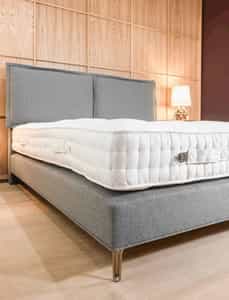
If the mattress beneath you limits the movement of heat and moisture away from the body, the warmth your body naturally releases may remain around the sleeping surface instead of dissipating efficiently. The body already knows how to begin cooling itself. The question is whether the surface beneath it helps or hinders that process.
Most modern mattresses are designed for logistics, not thermodynamics. They are compressed into boxes, stacked on pallets, and built around synthetic foam layers suited to large-scale manufacturing and transport.
Those materials also behave differently from natural fibre fillings, influencing how heat and moisture move through the sleep surface. As a result, the warmth your body naturally releases during the night may remain closer to you instead of dissipating as efficiently.
You may never fully wake up. Instead, you change position. You throw a leg out from under the duvet. You turn the pillow over. You search for a cooler spot on the bed. Instead of recovering from the city, you spend the night adjusting to your mattress.
True temperature regulation doesn't come from a machine mounted on the wall. It comes from the architecture of what you lie on.
The materials inside a mattress determine how heat and moisture move around the body throughout the night. That is why material choice becomes a matter of physical function, not simply refinement.
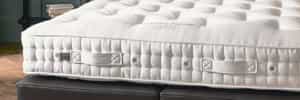
Every natural fibre inside a Vispring mattress performs a different role. Horsehair has long been valued in specialist textile applications for its durability, resilience and thermal comfort properties. Its natural resilience helps the mattress retain its loft over time, preserving the structure of the filling that encourages airflow [2].
Wool contributes differently. Naturally hygroscopic, it absorbs moisture vapour and gradually releases it again as surrounding conditions change, helping reduce humidity around the sleeper. Cotton completes the system by adding softness and breathability close to the body [3].
Vispring continues to use these natural fibres not because they are traditional, but because each performs a distinct function. Together they create a sleeping surface designed to work with the body's natural overnight cooling process rather than relying on synthetic cooling technologies.
The first morning after sleeping on a mattress built from naturally breathable materials brings a strange realisation. You didn't wake up to kick off the blanket. You didn't check the thermostat in the dark. You just slept. That is simple to overlook in a city that often tries to solve comfort with technology. Smarter thermostats. More powerful fans. Cooling sheets woven with synthetic fibres. Yet the most elegant solution is often the simplest: allowing heat and moisture to move naturally through breathable materials.
August in the city is a test of endurance. The concrete stores the day's heat, and the streets radiate it long after dark. Your home should be the place where that heat loop finally breaks. If you are still waking up hot in a freezing room, lowering the thermostat further may not solve the problem. The problem may not be the air around you. It may be the surface beneath you. True comfort isn't about chilling the air until your skin breaks into goosebumps. It is about allowing your body to release heat naturally throughout the night. That quiet consistency is what distinguishes a handcrafted sleep system from simply a cooler bedroom. This philosophy has shaped every Vispring mattress since 1901.
The finest sleep is the sleep we barely notice. Not because nothing happened, but because nothing interrupted it.
Even when the bedroom is cool, the temperature beneath the duvet can become much warmer. The mattress and bedding influence how efficiently heat and moisture move away from the body throughout the night.
Not necessarily. A cooler room supports sleep, but the body also needs an effective way to release heat through the sleeping surface.
Wool is naturally hygroscopic. It absorbs moisture vapour and gradually releases it again as surrounding conditions change, helping maintain a more stable sleeping environment.
Horsehair has long been valued in specialist textile applications for its durability, resilience and thermal comfort properties. Its resilience helps preserve the structure of the mattress fillings over time.
The mattress forms the part of the sleep environment that remains in direct contact with the body throughout the night, influencing how heat and moisture move around the sleeper.
Core temperature: The body's internal temperature, which naturally begins to decrease before sleep.
Hygroscopic: A material capable of absorbing moisture vapour from the surrounding air and releasing it again as conditions change.
Thermal comfort: The degree to which a person feels neither too hot nor too cold.
 (212) 792-7911459 Broome St, New York, NY1500 Lafayette Road, Portsmouth, NH